
Meissner Machine Mastery #1: Lecture Notes
Why Understanding Mechanics Matters
My goal for this lesson is straightforward:
If you can develop even a basic grasp of sewing machine mechanics, it will pay dividends down the road.
Because eventually, every sewist runs into problems:
- Skipped stitches
- Bird’s nests
- Jams
- Broken needles
- Feeding issues
And when that happens, understanding what the machine is trying to do gives you a much better chance of solving the problem.
A Quick Word on My Background
Before we dive in, here’s a bit of context.
I’m fourth generation in the sewing machine business.
- My great grandfather Stepik Schoenberg operated a factory in Argentina manufacturing sewing machine parts for Husqvarna Viking.
- His son, my grandfather Ramon Schoenberg, was a mechanical engineer who eventually began manufacturing a machine called the MADEX.
- In 1963, Ramon immigrated to Berkeley, California, fixing sewing machines part-time and teaching his son Marty repair work from a young age.
- Marty grew up to run a traveling repair business out of a van, mostly servicing industrial machines.
- In the late 1980s, Marty recruited my dad, Dan, and together they started The Sewing Machine Shop — Marty fixing, Dan selling.
I began servicing machines myself around 2010, and since 2020 I’ve been doing it full time.

Sewing Machines Are In My Blood → Read full story
How Does a Sewing Machine Make a Stitch?
Let’s define the function of a sewing machine:
A sewing machine binds multiple layers of fabric together using thread.
It does this by automating the ancient process of sewing by hands:
- The needle pokes a hole through fabric
- A knot forms between the needle thread and bobbin thread
- That knot gets cinched tight into the fabric
- The fabric advances forward
- The machine repeats the cycle
But how does that knot actually form?
To answer that, we need to look inside the machine.

Sewing Machine Anatomy → Read full story
The Two-Shaft System
At its core, a sewing machine is built around two rotating shafts:
- The upper shaft
- The lower shaft
When you press the foot pedal:
- The motor runs
- The belt turns
- Both shafts rotate
- Every critical mechanism moves in sync
All stitch formation comes down to what’s attached to these two shafts.
The Upper Shaft
The upper shaft drives two major components:
The Needle Bar

The needle bar does exactly what you’d expect:
- Moves the needle down through the fabric
- Then pulls it back up
Down, up, down, up — over and over again.
But the needle alone does not make a stitch. That requires the second component…
The Take-Up Lever

The take-up lever is one of the most important parts of the machine.
You see it every time you thread: Your thread passes through the take-up lever eyelet before going down to the needle.
Its job is critical: The take-up lever pulls the stitch tight.
A stitch forms below the needle plate, but it becomes a real seam only when the take-up lever:
- swings upward
- pulls the knot up
- cinches it into the fabric
The Classic “Bird’s Nest” Problem

If you ever accidentally thread the machine but miss the take-up lever…
Something awful happens:
- The knot never gets tightened
- Loose loops pile up underneath
- You get the dreaded bird’s nest
So when you see looping underneath, the first thing to check is: Did the thread go through the take-up lever?
The Critical Nature of the Take-up Lever → Read full story
Upper Shaft Review
So far:
- The needle penetrates the fabric
- The needle thread forms a loop underneath
- The take-up lever tightens the knot into the seam
Now we move to the lower half of the machine…
The Lower Shaft
The lower shaft drives two critical mechanisms:
- The Hook Mechanism
- The Feed Mechanism
Let’s start with the hook.
The Hook Mechanism: Where the Stitch Is Born
The hook rotates around the bobbin and bobbin case. Its timing is unbelievably precise.
Here’s what happens:
- The needle goes down
- Then rises about 2–3 mm from its lowest point
- At that exact moment, a loop forms in the needle thread
- The hook passes behind the needle
- The hook point catches that loop
That loop-catching moment is the foundation of the stitch.

Once the hook catches the loop:
- It carries the needle thread around the bobbin case
- The needle thread lassos the bobbin thread
- A loose knot forms underneath
Then the take-up lever pulls it tight.
That’s the lockstitch.
Skipped Stitches (And Why They Happen)

Skipped stitches occur when:
The hook fails to catch the needle thread loop. No loop caught = no stitch formed.
Common causes include:
Hook Timing Problems
If the machine is “out of time,” the hook arrives:
- too early (too high above the needle high)
- or too late (too low beneath needle eye)
This often happens after a jam. Fixing timing requires a technician.
Sewing Machine Timing → Read full story
Needle-Hook Clearance Issues

The hook must pass extremely close to the needle:
- Close enough to catch the loop
- Not so close that it hits the needle
Skipped Stitches Troubleshooting Flow Chart → Read full story
Bent Needles (The #1 Cause)

In my experience, the most common cause of skipped stitches is simple: A slightly bent needle.
Even a small bend changes everything.
So if you get skipped stitches, the first thing to do is: Replace the needle.
A fresh needle solves more problems than people realize.
Troubleshooting 101: Change the Needle → Read full story
The Feed Mechanism
Once the stitch is tightened, the fabric must move forward. That’s the job of the feed dogs.
Feed timing matters:
- While the needle is in the fabric, feed dogs drop below the plate
- Once the needle exits, feed dogs rise
- Then they move forward by the stitch length setting
If stitch length = 3 mm, fabric advances 3 mm.
Needle Strikes and Feeding Errors

Feed timing problems often show up when:
- Sewing thick fabric
- Pushing or pulling fabric manually
- Doing free-motion work
If fabric moves while the needle is down:
- Needles bend
- Hook gets struck
- Burrs form
- Bobbin cases get damaged
What Causes Needle Strikes? → Read full story
Conclusion: The Stitch Is a Symphony
To summarize:
- The upper shaft drives the needle bar and take-up lever
- The lower shaft drives the hook and feed mechanism
- The hook catches the loop
- The threads form a knot
- The take-up lever tightens it
- The feed dogs advance the fabric
- The cycle repeats
That’s how a sewing machine makes a stitch.
Coming Soon in Future Lessons

There are many other critical topics I’ll cover in future posts, including:
- Needles and proper selection
- Thread quality
- Tension systems
- Bobbin winding
- Presser feet
- Needle plates
- Check springs
- Needle threaders
So stay tuned.
And if you watch the video, I hope it gives you a deeper appreciation for the brilliant mechanics happening beneath the covers every time you sew.

Meissner Machine Mastery #1: Lecture Notes

Written By: Cale Schoenberg
Find More Inspiration
Shop The Best Deals
Juki Haruka TL-18QVP Sewing & Quilting Machine Juki Haruka TL-18QVP Sewing & Quilting Machine
Sewing & Quilting Machine
bernette B08 Straight Stitch Sewing Machine bernette B08 Straight Stitch Sewing Machine
Sewing & Quilting Machine
Juki TL-15 Quilting Machine Juki TL-15 Quilting Machine
Sewing & Quilting Machine
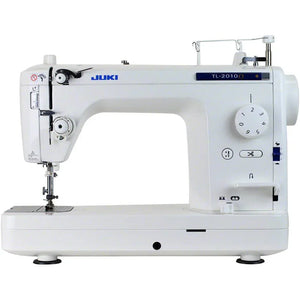
Juki TL-2010Q Sewing & Quilting Machine Juki TL-2010Q Sewing & Quilting Machine
Sewing & Quilting Machine
learning, machine guide
Compartir en:
-
 Share on Email
Se abre en una nueva ventana.
Share on Email
Se abre en una nueva ventana.
-
 Compartir en Facebook
Se abre en una nueva ventana.
Compartir en Facebook
Se abre en una nueva ventana.
-
 Share on Linkedin
Se abre en una nueva ventana.
Share on Linkedin
Se abre en una nueva ventana.
-
 Twittear en Twitter
Se abre en una nueva ventana.
Twittear en Twitter
Se abre en una nueva ventana.






Deja un comentario
Tenga en cuenta que los comentarios deben aprobarse antes de que se publiquen.